2026
UMIS-Mine: Robust RGB-D Instance Segmentation in Visually Degraded Underground Mine Scenes
Kaiyu Li, Feiteng Han, Yu Wang, Ming Xue, Xiao Zheng
International Conference on Intelligent Computing (ICIC), Springer, CCF-C 2026, pp. 3-14
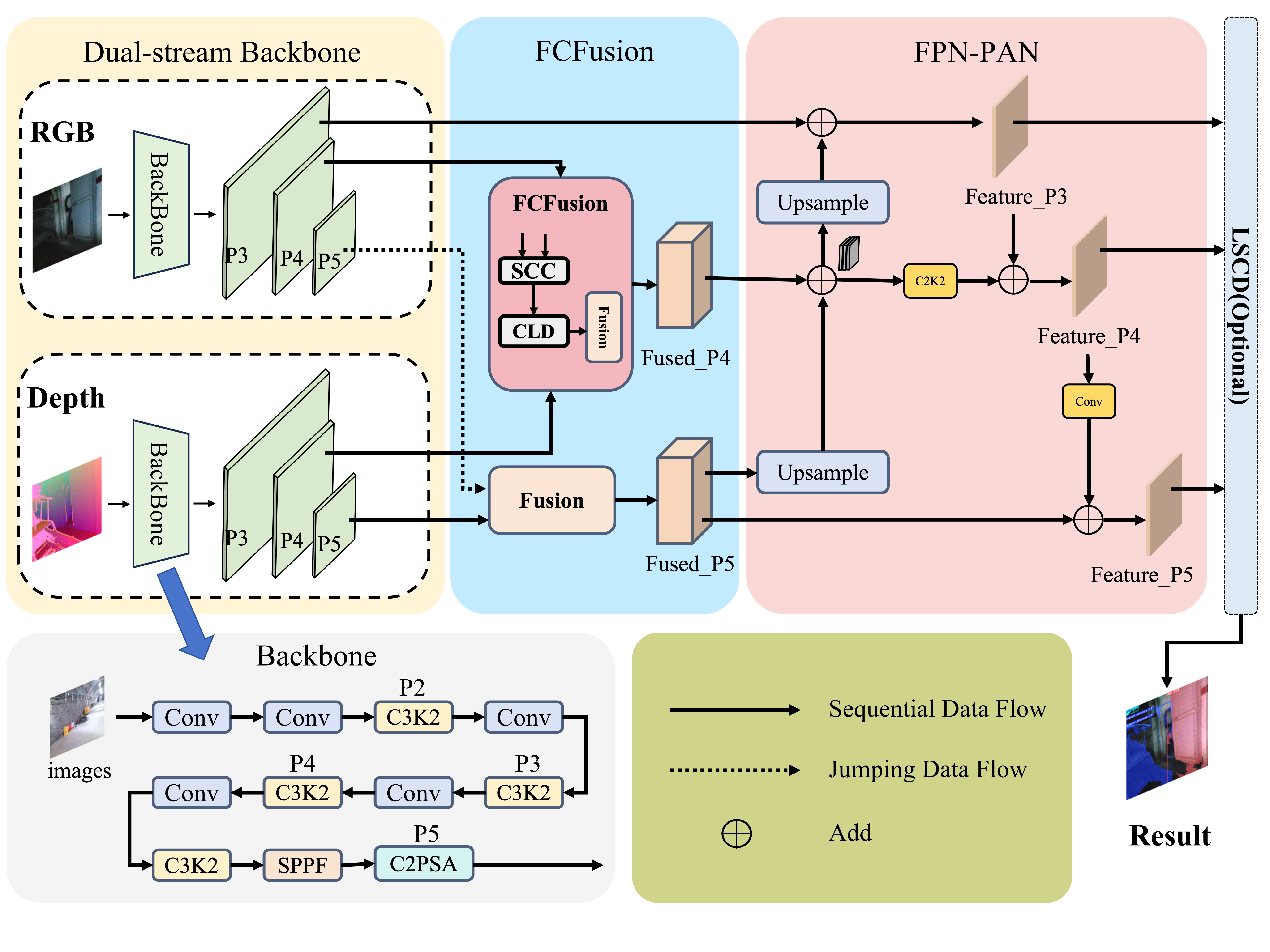
Instance segmentation in underground mines remains challenging due to severe visual degradation, including low illumination, dust interference, cluttered backgrounds, and frequent occlusions, which limit the development of embodied robotic perception. Although RGB-D sensing provides complementary appearance and geometric cues, effective multimodal fusion is hindered by cross-modal misalignment and modality-specific noise. To address these issues, we propose UMIS-Mine, a robust RGB-D instance segmentation framework for visually degraded underground mine scenes. The proposed framework adopts a dual-stream architecture and introduces a Feature Correction and Fusion module (FCFusion), which performs spatial cross-compensation and channel-level denoising to improve feature alignment and fusion robustness. In addition, we construct MUSeg-Ins, a new RGB-D instance segmentation dataset containing 3,171 aligned image pairs and 34,244 instance annotations across 11 categories. Evaluations on MUSeg-Ins and NYU Depth V2 demonstrate UMIS-Mine's superior accuracy and generalizability, achieving 51.5% and 49.3% mask mAP50 respectively, outperforming representative CNN and Transformer baselines. We further explore an optional Lightweight Shared Convolutional Decoder (LSCD) for resource-constrained deployment, which offers a compact alternative while revealing the trade-off between efficiency and segmentation accuracy.
UMSBench-v1: A Real-Synthetic Composited Multimodal Benchmark Dataset for Underground Mine Safety
Feiteng Han, Ming Xue, Kaiyu Li, Tao Feng, Wei Shen, Hui Wang, Yudong Fang, Yu Wang, Xuecheng Tan
ACM Multimedia (ACM MM) 2026, CCF-A 2026 已录用录用
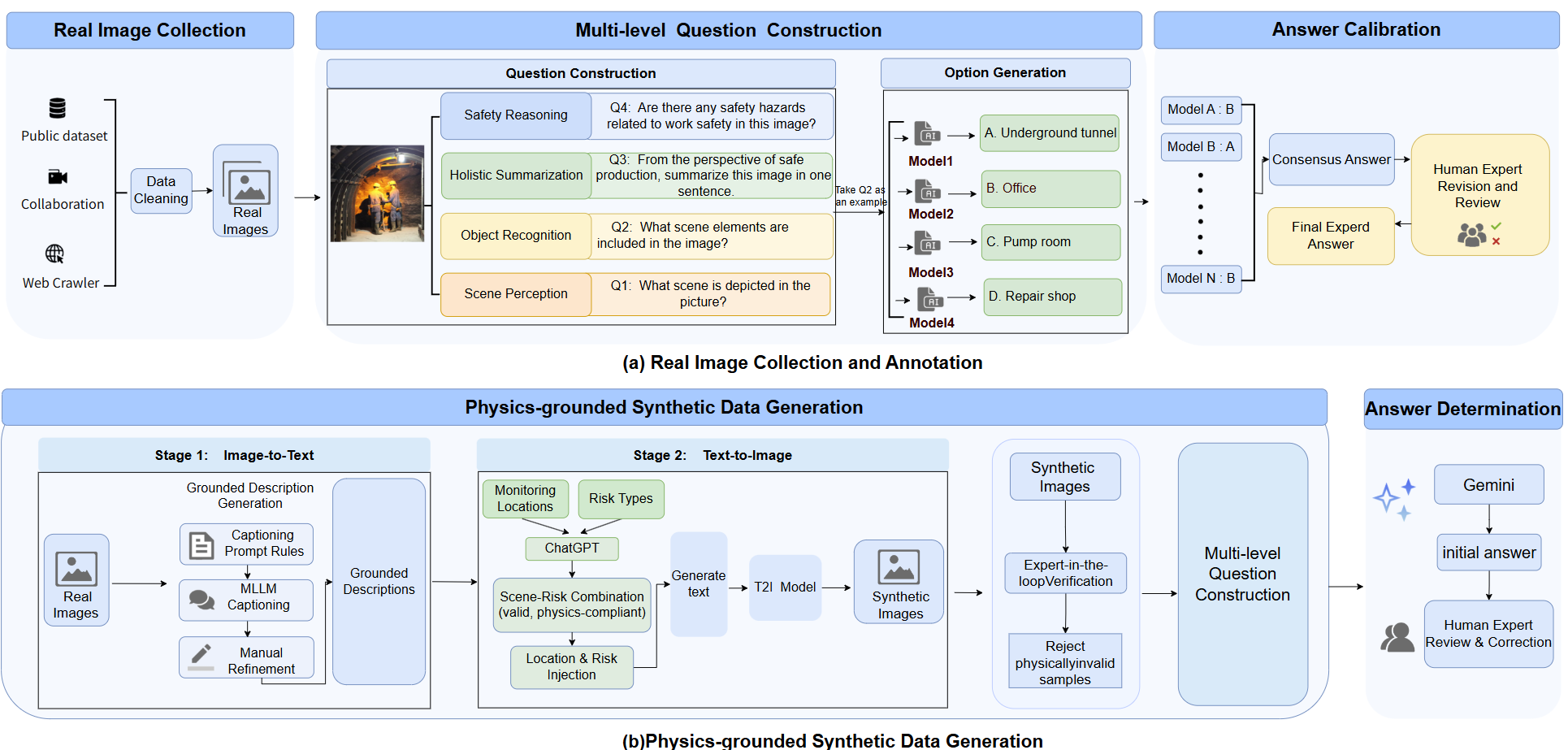
To fill the gap on benchmark datasets for vision language models (VLM) research on underground mining safety analysis, we introduce UMSBench-v1.0. As the first multimodal VQA benchmark dataset and also the first real-synthetic image dataset on mining safety, it consists of 10,000 real-synthetic underground images and 40,000 question-answer pairs correspondingly, and covers safety reasoning, captioning, understanding and perception over 30 underground mining site types. The synthetic data are generated with newly proposed Image-to-Text-to-Image (I2T2I) mechanism based on refined LLM-driven captioning capabilities, prompting engineering and visual content generation models. Moreover, benchmarking tasks are reformulized as Single-Choice Questions (SCQs) with advanced VLMs and human experts as references to archive higher flexibility, scalability and efficiency. State-of-the-art vision language models are bench-marked and finetuned to demonstrate the dataset's effectiveness and potential application. The dataset will be released at https://github.com/BCU-AILAB/UMSBench.
2025
Chaotic Activity Filtering Approach of Business Process Based on The Directly-Follows Relation
Tengzi Lv, Xiugang Gong, Muhammad Tahir, Na Gong, Kaiyu Li
International Journal of Computer Science & Network Security (IJCSNS) 2025, Vol. 25, No. 2, pp. 169-187
Process discovery aims to discover process models from event logs to describe actual business processes. However, chaotic activities may exist in real business scenarios, and the occurrence of chaotic activities is independent of other activities in the process and can occur at any location in the event log at any frequency. Therefore, chaotic activities seriously affect the approach quality of process discovery. Filtering chaotic activities in event logs can effectively improve the quality of event logs and thus improve the quality of process models. The traditional chaotic activity filtering algorithm is difficult to balance accuracy and time performance. Therefore, new approaches for filtering chaotic activities are proposed in this paper. By analyzing the relation between activities, chaotic activities are identified in the log according to the characteristics of chaotic activities and the directly-follows relation of activities as the judgment conditions, and the filtering of chaotic activities in the event log is realized. The proposed approaches are compared with the traditional chaotic activity filtering approaches on several simulation/real data sets, and the accuracy and running time between the multi-group event logs and the process models generated before and after chaotic activity filtering are analyzed, further verifying the effectiveness and feasibility of the proposed approaches.
2024
Pre-processing event logs by chaotic filtering approaches based on the direct following relationship
Tengzi Lv, Xiugang Gong, Na Gong, Kaiyu Li
Applied Sciences (MDPI) 2024, Vol. 14, No. 16, 6994
Process discovery aims to discover process models from event logs to describe actual business processes. The quality of event logs has an impact on the quality of process models, so preprocessing methods can be used to improve the quality of event logs. Chaotic activities may exist in real business scenarios, and the occurrence of chaotic activities is independent of other activities in the process and can occur at any location in the event log at any frequency. Therefore, chaotic activities seriously affect the model quality of process discovery. Filtering chaotic activities in event logs can effectively improve the quality of event logs and thus improve the quality of process models. The traditional chaotic activity filtering algorithm makes it difficult to balance accuracy and time performance. Therefore, a direct method for filtering chaotic activities is proposed in this paper. By analyzing the relationship between activities, chaotic activities are identified in the log according to the characteristics of chaotic activities and the direct following relationship of activities as the judgment condition, and the filtering of chaotic activities in the event log is realized. In addition, this paper proposes an indirect chaotic activity filtering method, which identifies and filters chaotic activities in the log by analyzing the influence of the existence of different activities on the overall chaos degree of the log. The proposed method is compared with the traditional chaotic activity filtering method on several simulation/real data sets, and the accuracy and running time between the multi-group event logs and the process models generated before and after chaotic activity filtering are analyzed, further verifying the effectiveness and feasibility of the proposed method. By summarizing the experimental results, it is found that the accuracy of the proposed chaotic activity filtering methods is greater than that of the frequency-based filtering method and is close to that of the entropy-based chaotic activity filtering methods. Moreover, compared with other filtering methods used in the experiment, the chaotic activity filtering method proposed in this paper can improve the efficiency by 23.4% on average for simulation logs, and by 84.25% on average for real event logs. It is concluded that compared with other filtering methods, the proposed chaotic activity filtering methods have higher accuracy and can effectively improve the time performance of chaotic activity filtering. Therefore, the chaotic activity filtering method proposed in this paper can balance the accuracy and time performance, and can ensure the integrity of the filtered event log to a certain extent.
2022
Towards path planning algorithm combining with A-star algorithm and dynamic window approach algorithm
Kaiyu Li, Xiugang Gong, Muhammad Tahir, Tao Wang, Rajesh Kumar
International Journal of Advanced Computer Science and Applications (IJACSA) 2023, Vol. 14, No. 6
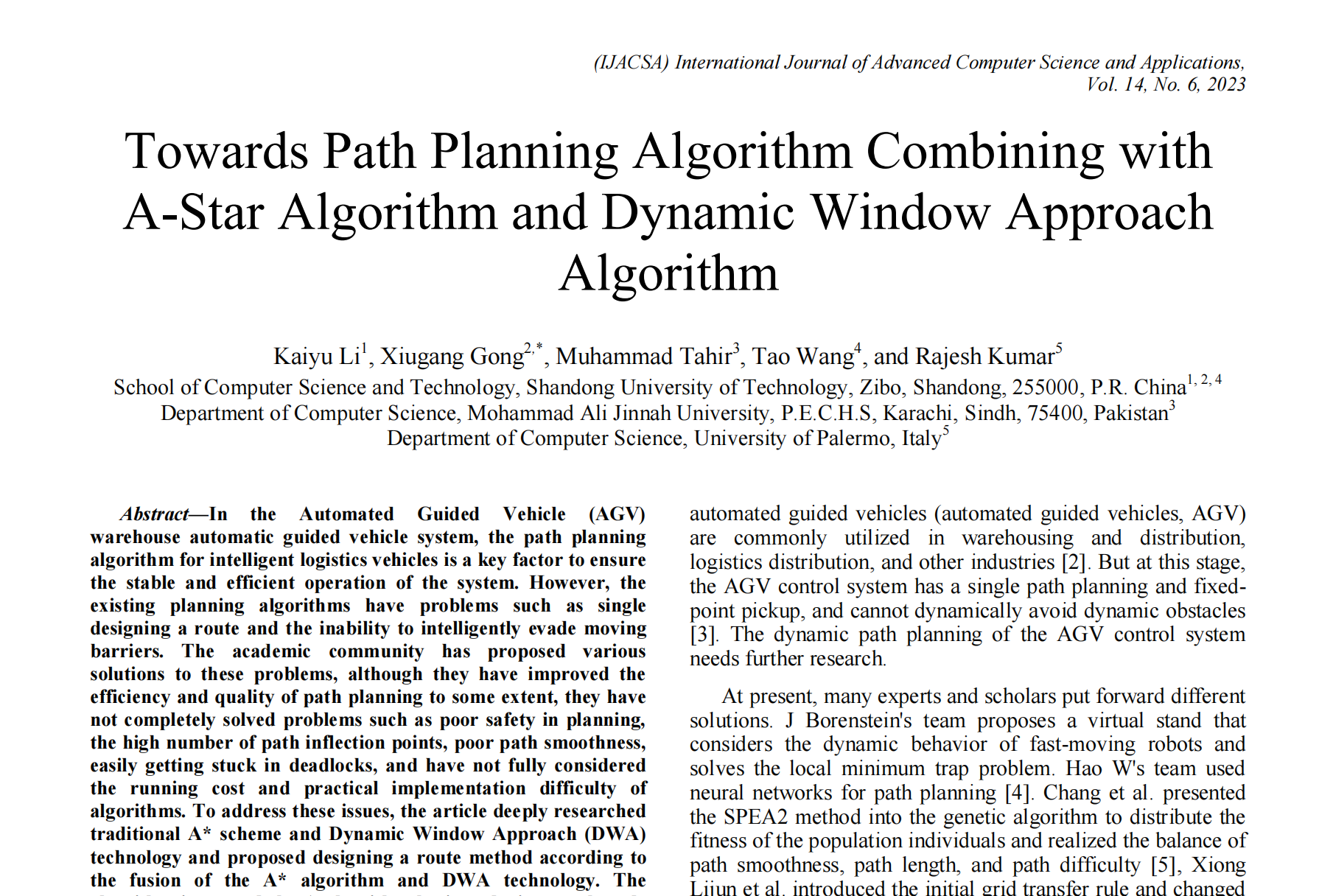
In the Automated Guided Vehicle (AGV) warehouse automatic guided vehicle system, the path planning algorithm for intelligent logistics vehicles is a key factor to ensure the stable and efficient operation of the system. However, the existing planning algorithms have problems such as single designing a route and the inability to intelligently evade moving barriers. The academic community has proposed various solutions to these problems, although they have improved the efficiency and quality of path planning to some extent, they have not completely solved problems such as poor safety in planning, the high number of path inflection points, poor path smoothness, easily getting stuck in deadlocks, and have not fully considered the running cost and practical implementation difficulty of algorithms. To address these issues, the article deeply researched traditional A* scheme and Dynamic Window Approach (DWA) technology and proposed designing a route method according to the fusion of the A* algorithm and DWA technology. The algorithm improved the A algorithm by introducing a sub-node optimization algorithm to solve problems for instance poor global path planning safety and easy deadlock. Moreover, the algorithm reduced the amount of global route reversal locations and increased path consistency by improving the evaluation function and removing redundant points of the A algorithm. Finally, by integrating the DWA algorithm, the intelligent logistics vehicle achieved dynamic obstacle avoidance capabilities for moving objects in the real world. Our simulations-based results on MATLAB framework show that the algorithm significantly improves path smoothness, path length, path planning time, and environmental adaptability compared to traditional algorithms, and basically meets the path planning requirements of the AGV system for intelligent logistics vehicles.